

EN

Deep Plane Facelift
Naturally appearing facial rejuvenation through modern Deep Plane surgery
Is a Deep Plane Facelift the correct treatment for you?
That is decided by anatomy, not by age. Ask your question directly on WhatsApp – no appointment needed. Or arrange a consultation straight away.
Deep Plane Facelift
The Deep Plane Facelift is considered one of the most advanced procedures in surgical facial rejuvenation today. Unlike traditional facelift techniques, it does not solely tighten the skin but specifically repositions the deeper anatomical structures of the face.
This allows for effective treatment of sunken cheek areas, pronounced nasolabial folds, a lost jawline, and age-related changes in the midface.
At SA Aesthetics, the focus is not on maximum tightening, but on restoring natural proportions and a fresh, rejuvenated appearance.
What is a Deep Plane Facelift?
The Deep Plane Facelift is considered one of the most advanced procedures in surgical facial rejuvenation today. Unlike traditional facelift techniques, it does not solely tighten the skin but specifically mobilizes the deeper anatomical structures of the face and returns them to their original position.
As we age, the skin, connective tissue, and deeper tissue layers lose elasticity. The cheeks sag, the jawline loses definition, and wrinkles around the mouth and nose become more pronounced. These changes occur not only at the skin's surface but primarily in the deeper anatomical layers of the face.
The Deep Plane Facelift addresses this very cause. By treating the deeper tissue structures, sunken facial areas can be lifted, and natural contours restored without creating an overly tight or mask-like appearance.
The goal is not to change the face but to restore lost proportions and achieve a fresh, rejuvenated, and natural appearance.
Why does the face age?
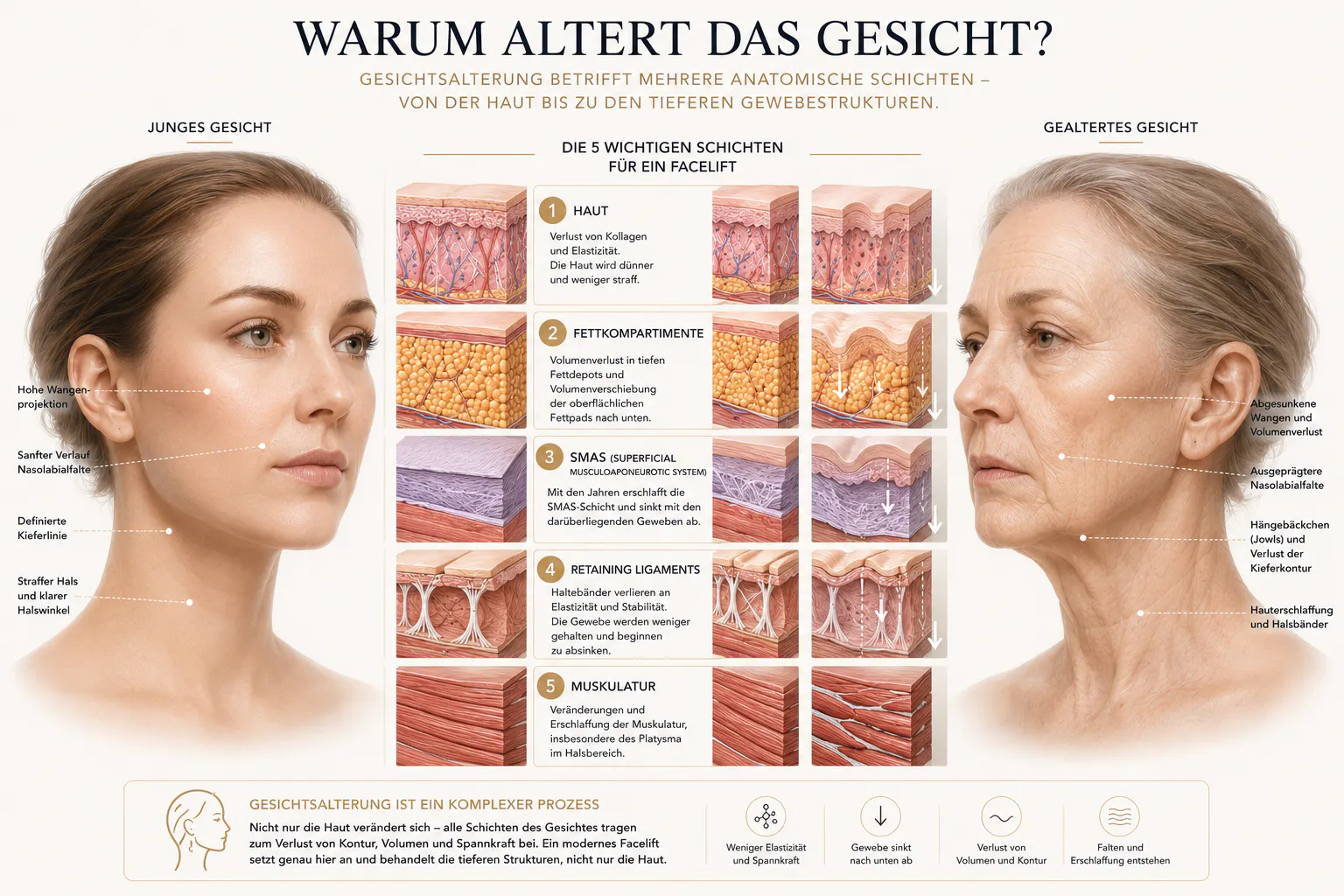
The aging process of the face is significantly more complex than mere skin laxity. As we age, the skin, fat tissue, connective tissue, muscles, support structures, and even the bony foundations of the face change. These changes collectively lead to the loss of contours, making the face appear more tired, heavier, or less defined. While many people initially notice fine lines or a decrease in skin tension, the actual aging processes often begin in the deeper anatomical structures of the face. For this reason, treating only the skin is often insufficient in advanced age-related changes.
Skin aging – loss of collagen and elasticity
With age, the production of collagen, elastin, and hyaluronic acid gradually decreases. The skin becomes thinner, drier, and loses elasticity. At the same time, tissue regeneration slows down, and external factors such as UV radiation, smoking, or environmental pollutants further exacerbate this process.
The result is finer lines, wrinkles, and a decline in skin quality. Although these changes are visible, they usually represent only a part of the overall aging process.
Changes in fat compartments
The face does not simply lose volume over the years. In fact, the various fat compartments of the face change in different ways. While some fat deposits lose volume, others sag downward due to gravity and the declining stability of the support structures.
This leads to typical signs of aging such as sunken cheeks, deeper tear troughs, more pronounced nasolabial folds, and so-called marionette lines around the corners of the mouth. At the same time, the face loses projection and appears less fresh and rested.
Sagging of SMAS and deep tissue structures
A central role in facial aging is played by the so-called SMAS (Superficial Musculoaponeurotic System). This is a connective tissue-muscular layer that connects large parts of the facial soft tissues and is primarily responsible for the contours of the face.
As we age, this system loses stability. The deeper tissue structures gradually sag, causing the cheeks to lose their position, the jawline to appear less defined, and so-called jowls to develop.
This is where the Deep Plane Facelift comes into play, as it treats not only the skin but also these deeper anatomical structures.
Changes in the facial retaining ligaments
In addition to the SMAS, the so-called retaining ligaments play a crucial role. These connective tissue structures anchor the skin, fat tissue, and deeper facial layers to the underlying structures.
Over the years, these retaining ligaments lose stability and elasticity. As a result, tissue structures can sag more easily, leading to typical age-related changes in the midface, along the jawline, and in the neck area.
Mobilizing these retaining structures is one of the essential features of modern Deep Plane Facelift techniques and represents a significant difference from many classic facelift procedures.
Muscle changes and neck aging
The muscles of the face, particularly in the neck area, also change over time. In the neck, the platysma, a superficial neck muscle, can lose tension. This results in visible neck bands, excess skin, and a less defined separation between the chin and neck.
These changes significantly affect the perception of an aged face and often occur alongside changes in the midface and jawline.
Changes in the bony facial structure
Less well-known but scientifically well-documented are age-related changes in the facial skeleton. As we age, certain bony structures of the face change. Areas around the eye sockets, the cheekbones, and parts of the upper and lower jaw lose projection and support.
As a result, the overlying soft tissues lack important support structures. The face loses definition, and the effects of tissue sagging and volume loss are further intensified.
Facial aging is more than just skin aging
The visible signs of aging arise from the interplay of all these processes. Skin laxity, volume changes, the sagging of deeper tissue structures, changes in the retaining ligaments, and bony remodeling processes all influence each other.
For this reason, modern facelift techniques do not focus solely on the skin surface. The goal of a Deep Plane Facelift is to address the deeper anatomical causes of facial aging to restore natural contours and achieve a harmonious, long-lasting rejuvenation of the face.
Why do some facelifts look unnatural?
One of the most common concerns among patients before a facelift is the fear of an artificial or "operated" appearance. Many people still associate facelift surgeries with overly tightened facial features, altered expressions, or the so-called "wind tunnel look."
This appearance often arises when tension is primarily applied to the skin while the actual causes of facial aging lie in the deeper anatomical structures. If sagging cheeks, fat compartments, and retaining structures are not adequately considered, facial features can appear unnaturally tight or pulled sideways.
Modern facelift techniques therefore take a different approach. Instead of tightening as much skin as possible, the focus is on restoring natural proportions and contours. The goal is not to change the face but to correct age-related changes while preserving the individual's expression, personality, and charisma.
The best facelift results are often recognized precisely because they are not perceived as surgery. Patients appear fresher, more rested, and more harmonious without losing their natural identity.
Deep Plane Facelift vs. classic facelift and SMAS facelift
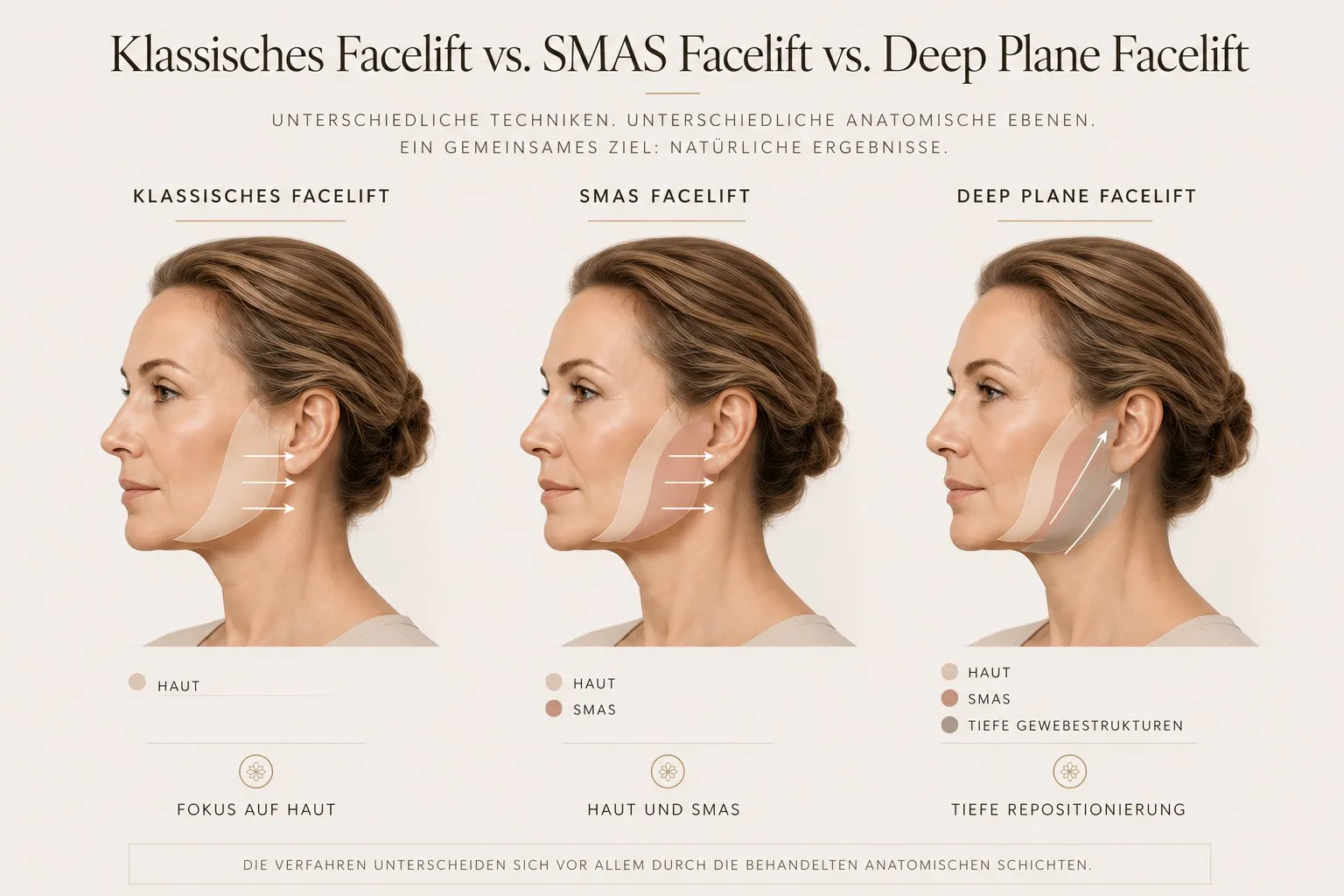
Over the course of the development of modern facelift techniques, various surgical procedures have been established. The most well-known include the classic facelift, the SMAS facelift, and the Deep Plane facelift. All procedures fundamentally pursue the same goal: correcting age-related changes and restoring harmonious facial contours. The differences lie primarily in the anatomical layers treated during the surgery.
What changes does a facelift correct?
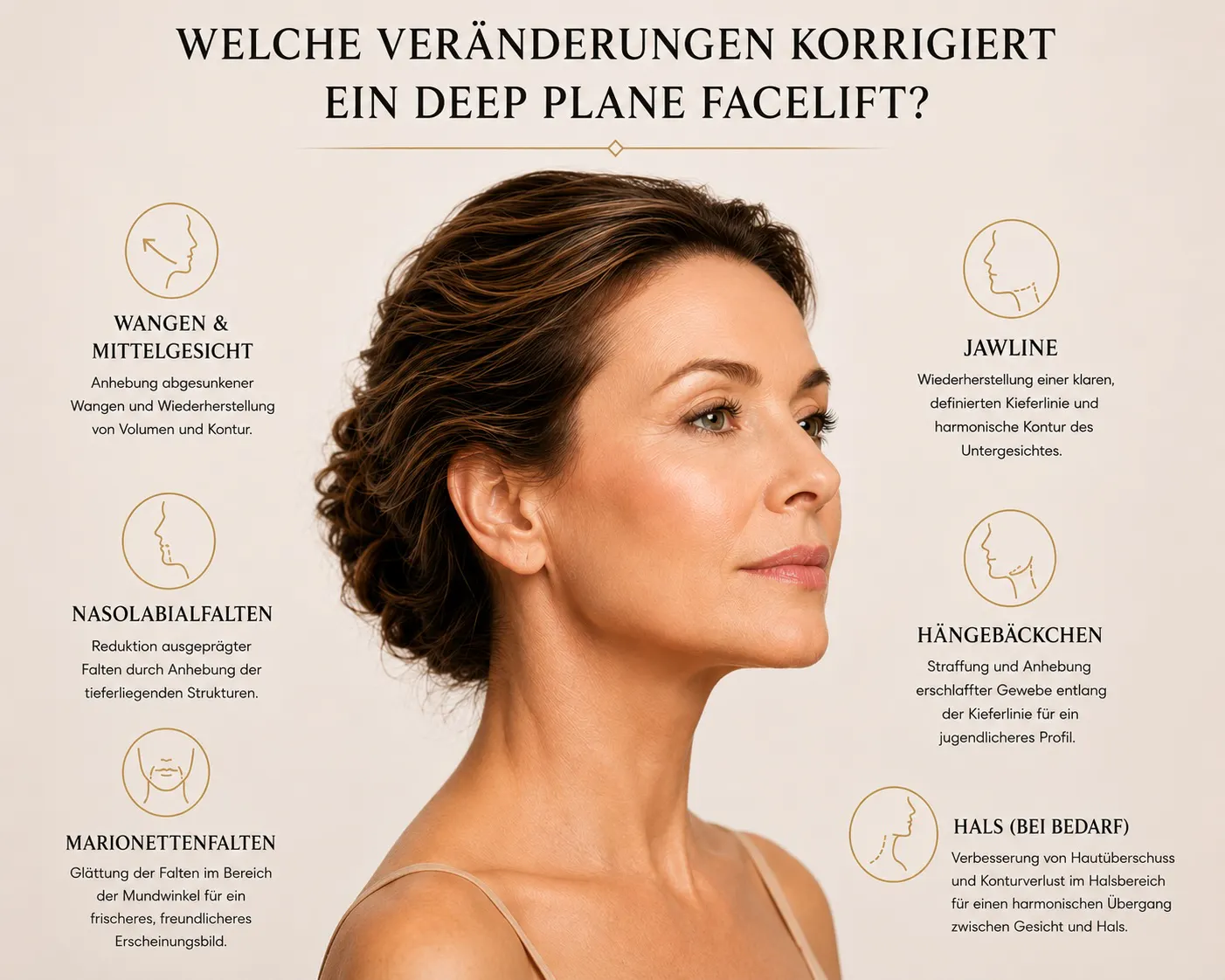
A deep plane facelift does not treat individual wrinkles but rather the deeper causes of facial aging. By repositioning sagging tissue structures, various age-related changes in the face can be harmonized simultaneously.
These include particularly:
sagging cheeks and volume loss in the midface
prominent nasolabial folds
jowls along the jawline
loss of a well-defined jawline
marionette lines around the corners of the mouth
age-related contour losses at the transition between the face and neck
The goal is not to change facial features but to restore natural contours and proportions. Modern deep plane techniques address the deeper anatomical causes of facial aging and not just their visible effects on the skin surface.
Deep Plane Facelift or minimally invasive treatments?
Minimally invasive treatments such as neuromodulators, hyaluronic acid, biostimulators, or modern laser and radiofrequency procedures can often effectively treat early signs of skin and facial aging. In particular, skin quality, fine wrinkles, or moderate volume loss can be specifically improved.
However, with increasing aging, changes occur that do not only affect the skin surface. Deeper tissue structures sag, fat compartments change their position, and natural facial contours lose definition.
In contrast to minimally invasive procedures, a deep plane facelift addresses these deeper anatomical causes of facial aging. By repositioning sagging tissue structures, natural contours can be restored and age-related changes corrected in the long term.
Which treatment is appropriate always depends on individual anatomy, the extent of age-related changes, and personal treatment goals. During a personal consultation, we will discuss together which treatment concept is best suited for your situation.
Which facelift method is right for me?
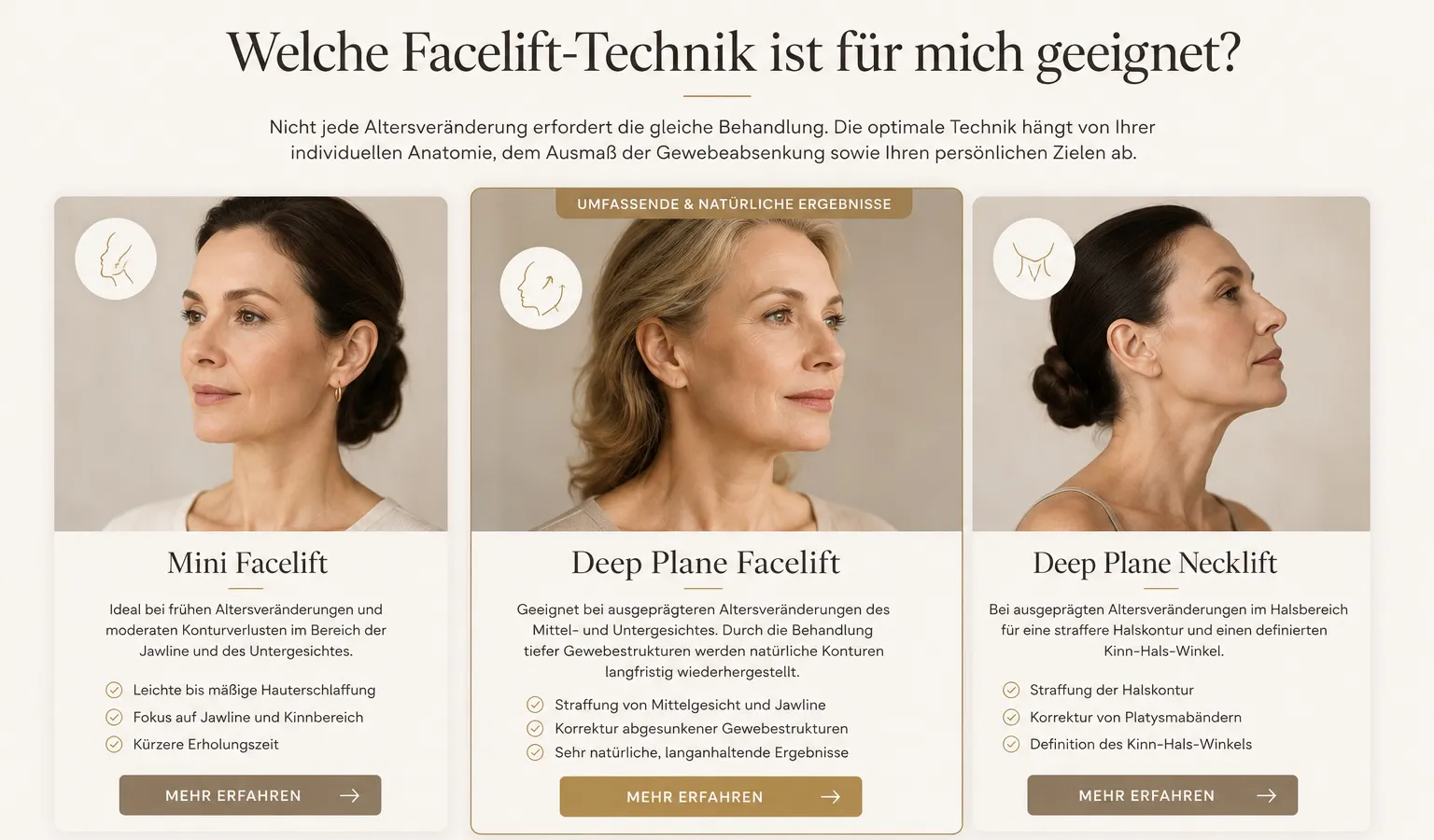
The choice of the appropriate facelift technique depends on many factors, including the extent of age-related changes, skin quality, facial anatomy, and individual treatment goals.
Chief Physician Themistoklis Stavrakis, M.D., a specialist in Plastic and Aesthetic Surgery, generally recommends modern facelift techniques that take into account the deeper anatomical structures of the face. Pure skin tightening procedures without addressing the underlying tissue layers are now rarely performed.
Where anatomically sensible and medically appropriate, modern SMAS and especially Deep Plane techniques are preferred, as these often provide the most natural and long-lasting results. However, which method is right for each individual case always depends on the person's anatomy and personal treatment goals.
Decision Based on Age & Skin Condition
Facelift for Significant Skin Excess
Facelift for Early Skin Sagging
Deep Plane Facelift for Men
Procedure of a Deep Plane Facelift at SA Aesthetics

Individual Analysis Instead of Standard Solution
Every face ages differently. Therefore, each treatment begins with a detailed analysis of facial anatomy, aging processes, and your personal wishes and expectations. The goal is to develop an individual treatment plan that respects your facial features and allows for natural results.
Precise Planning of Facial Rejuvenation
Before the procedure, the relevant facial regions are analyzed, and the planned repositioning of the tissue structures is individually determined. The focus is not on individual wrinkles, but on restoring harmonious facial contours and natural proportions.
Execution of the Deep Plane Facelift
The procedure is performed under general anesthesia and lasts several hours, depending on the initial condition and extent of treatment. Through precisely placed and later as inconspicuous as possible incisions, the deeper anatomical structures are mobilized and returned to their original position.
Unlike a pure skin tightening procedure, the correction is not performed on the surface, but in the deeper tissue layers of the face.
Aftercare and Recovery
After the procedure, there is close follow-up care. Swelling and bruising are normal in the first few days and gradually subside during the healing process. Through regular check-ups, we support our patients throughout the entire healing process and are available for any questions at any time.
Healing & Recovery Time After a Facelift
Depending on the surgical technique, you will be socially acceptable again after 10-14 days. Light makeup can often be used after just one week.
The Healing Process in the First Weeks
- Week 1-2: Swelling, light bruising, feeling of tension
- Week 3-4: Significant reduction of symptoms, first results visible
- From week 6: The face looks refreshed, the scars are hardly visible
- After 3-6 months: The tissue has largely stabilized and the final result can be assessed. The facial contours appear harmonious, natural, and rejuvenated in the long term.
Results and Longevity of a Deep Plane Facelift

The goal of a Deep Plane Facelift is not to create a new face. Rather, it aims to correct age-related changes and restore lost facial contours. A successful facelift should make patients look fresher, more rested, and younger, without altering their individual expression.
For this reason, I often ask many of my patients to bring older photos of themselves to the consultation. These images often help to better understand the individual aging processes and how facial contours, volume distribution, and tissue structures have changed over the years.
Therefore, the goal of the treatment is not to create a new appearance, but to restore, as naturally as possible, those facial features that have characterized the patient for many years.
Naturalness and Expression After a Deep Plane Facelift
How long does a Deep Plane Facelift last?
Risks and Possible Complications of a Deep Plane Facelift
Like any surgical procedure, a Deep Plane Facelift carries general and procedure-specific risks. Careful surgical planning, modern surgical techniques, and strict adherence to aftercare recommendations help minimize risks. In the personal consultation, all individual risks and specifics are discussed in detail.
Risk Minimization Through Surgical Expertise
A Deep Plane Facelift is one of the most technically demanding procedures in aesthetic facial surgery. Careful analysis, precise surgical planning, and gentle surgical techniques are essential prerequisites for a safe and natural result.
Chief Physician Themistoklis Stavrakis, M.D., a specialist in Plastic and Aesthetic Surgery, has been intensively involved with modern Deep Plane and SMAS facelift techniques for many years. Each treatment is individually planned and tailored to the patient's personal anatomy and aesthetic goals.
Equally important as the surgery itself are structured aftercare and regular follow-up appointments. Through close supervision before, during, and after the procedure, healing processes can be monitored and potential problems identified early.
Even more complex initial situations, such as after previous surgeries or with pronounced tissue sagging, are treated with surgical experience and precise techniques.
Combinations with Other Procedures
A Deep Plane Facelift can be combined with additional procedures if necessary to achieve the most harmonious and natural overall result. Which combination is sensible depends on the individual anatomy, the extent of age-related changes, and the personal treatment goals.



My Philosophy Behind a Natural Facelift
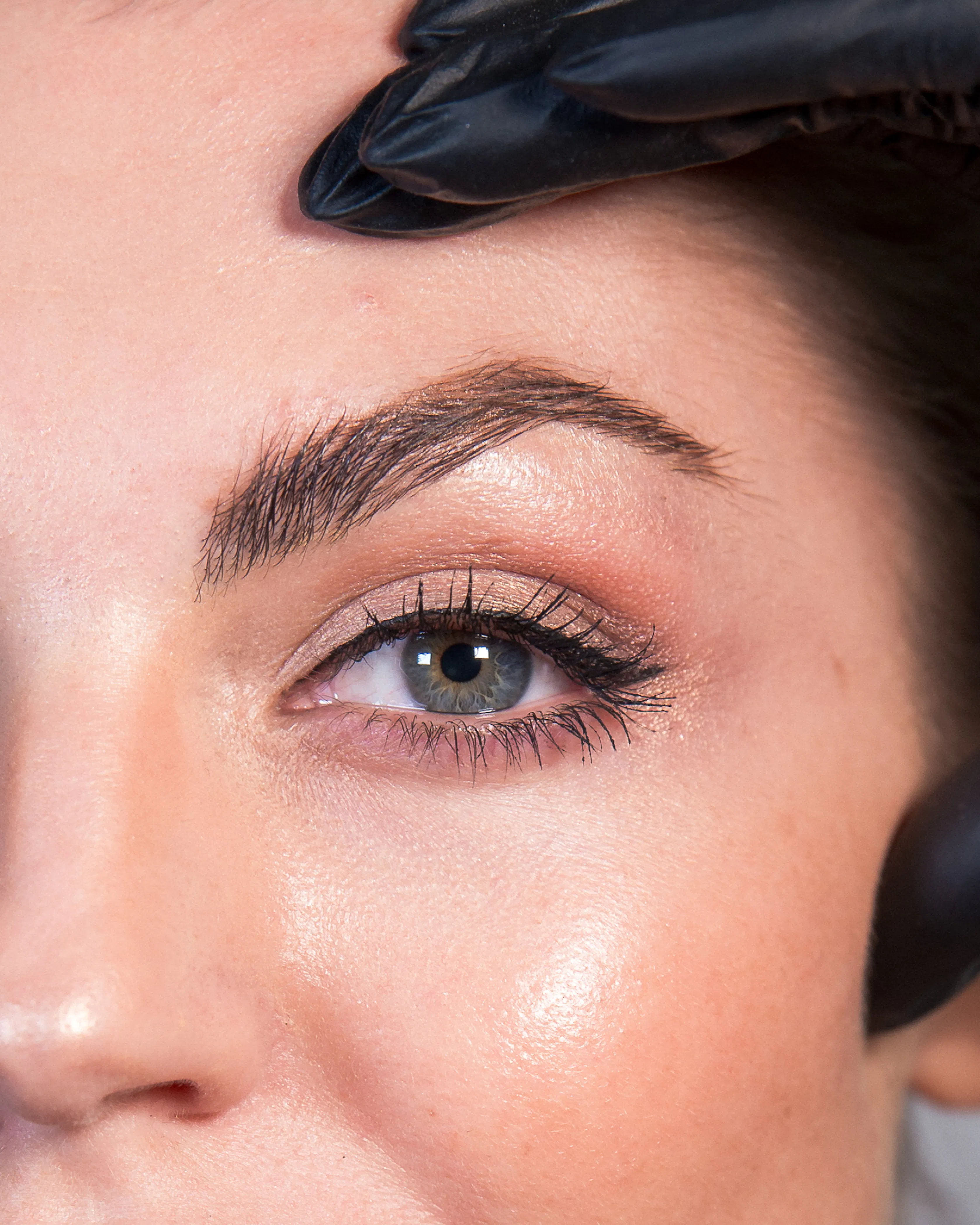
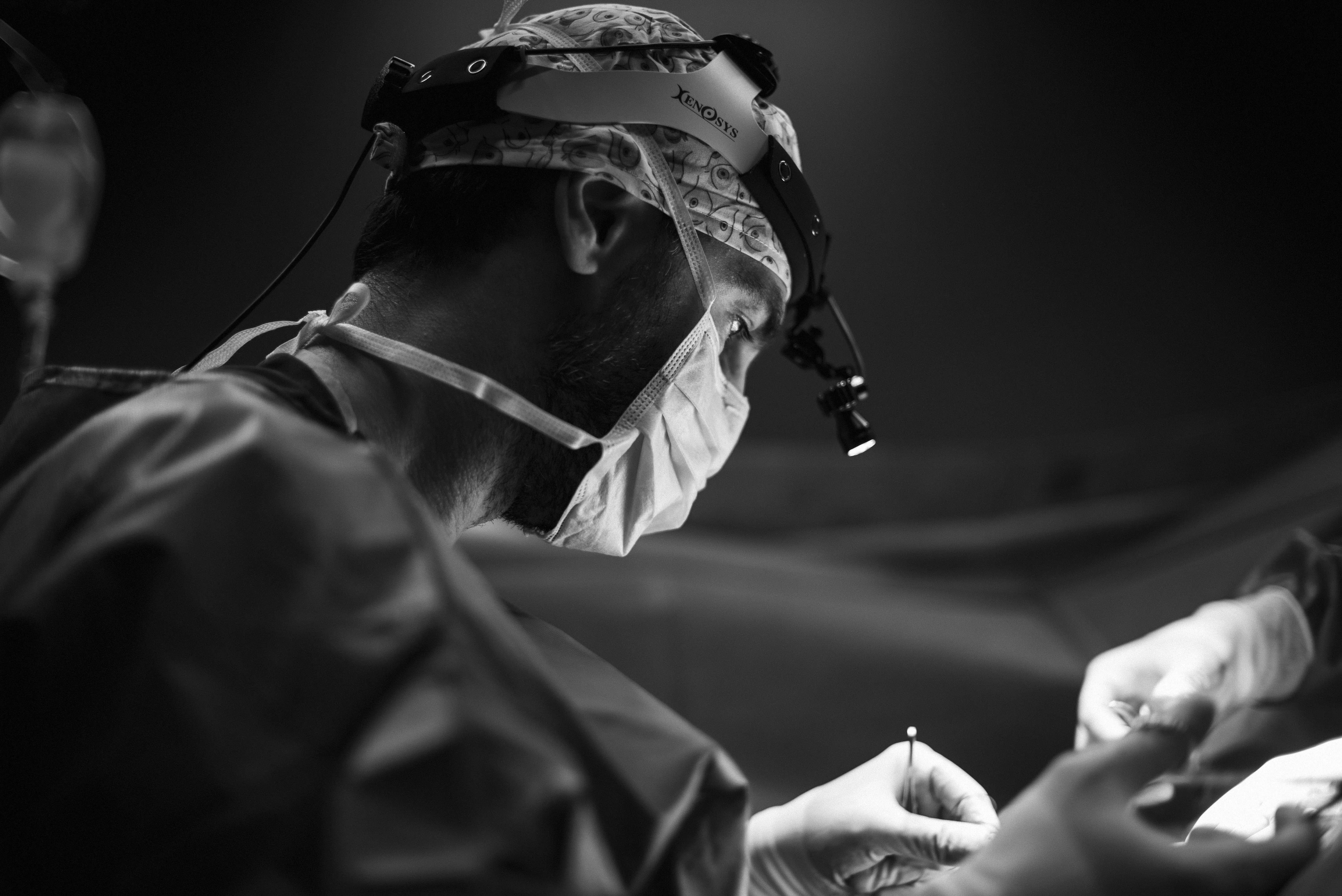
Throughout my training and my work as a plastic surgeon, I have developed my own philosophy of facial rejuvenation. For me, a facelift is not about creating a new face or stopping time. Rather, I see my role as understanding age-related changes, restoring lost contours as naturally as possible, and preserving the individual personality of a person. In my view, a successful facelift is not recognized by someone looking operated on. Ideally, friends, family, or colleagues simply perceive that a person looks fresher, more rested, and more vibrant, without being able to pinpoint the cause directly. Regardless of whether a mini facelift, SMAS facelift, or deep plane facelift is performed, I adhere to the same fundamental principles in every facial surgery: maximum safety, natural results, long-term outcomes, and an individualized treatment that respects the personality and anatomy of each patient.
Frequently Asked Questions about the Deep Plane Facelift
This is one of the most common questions my patients ask me – and I completely understand. A successful Deep Plane Facelift should not change you but rather restore what time has taken away: natural contours, freshness, and vitality. Friends and family often only notice that you look more rested and vibrant – without being able to pinpoint the reason. That is the goal.
Yes – and this is particularly important to me. Modern deep-plane techniques rejuvenate the face not through excessive skin tension but by restoring natural anatomical relationships. Your expressions, your aura, your face – it remains yours.
Many of my patients enjoy improved facial contours and a rejuvenated appearance for 10 to 15 years. Of course, individual factors play a role – genetics, sun exposure, smoking, weight, and lifestyle. A facelift does not stop the aging process, but it sets the clock back a bit – and you can feel that.
Most patients feel comfortable returning to social activities after 10 to 14 days. Swelling and slight bruising may still be present at this time but are often hardly noticeable to outsiders. Healing varies for everyone – I will guide you through it step by step.
Most patients report more of a feeling of tension and swelling rather than severe pain. Discomfort can be well managed with appropriate pain relief and decreases continuously in the first few days after the Deep Plane Facelift. You are not alone during this phase – our team is always available to assist you.
Early mobilization is explicitly encouraged – I recommend light walks as early as the first day after surgery. Light daily activities are usually possible after a few days. However, you should refrain from more intense exercise for three to four weeks to avoid jeopardizing the healing process. We will discuss exactly what is allowed when during your follow-up appointments.
A Deep Plane Facelift does not change who you are – it restores how you should look. The goal is not to alter your personality or distinctive facial features but to gently correct age-related changes and bring back lost contours. A successful result makes you look like a fresher, more rested version of yourself – distinctly you, just more vibrant.
There is no blanket answer to this – and I would be skeptical of anyone who promises you one. Many patients look noticeably fresher and more rested after a successful facelift. My goal is not to trim you to a specific age but to restore your natural radiance and lost contours as authentically as possible.
Of course. Men also often desire a fresher and more rested appearance without sacrificing naturalness or masculine features. The Deep Plane Facelift for men takes into account the unique anatomical characteristics of the male face – the planning is accordingly adjusted, but the goal remains the same: an authentic, natural result.
Yes, and it is a point I raise openly with my patients. Larger changes in weight can significantly affect facial volume and influence the long-term appearance after a facelift. Ideally your target weight should be largely stable before the procedure – this creates favourable conditions for a result that holds up over time.
When you lose weight quickly, it is not only the body that loses volume – the face does too. The fat compartments in the cheeks and temples shrink, the deeper tissue layers descend, and the skin sits more loosely. The face looks slimmer, but also more tired and older. This is precisely what a Deep Plane Facelift addresses: it does not tighten the skin, but releases the descended deep tissue layer and returns it to its original position. Because the tension is not carried by the skin, the procedure works with your own anatomy rather than pulling the surface. Lost volume can additionally be restored with a fat transfer, depending on the individual findings.
Nicotine impairs blood circulation in the tissue and significantly increases the risk of wound healing complications after a facelift. Therefore, I recommend my patients to completely refrain from smoking for at least two weeks before and after the surgery. It is one of the simplest measures you can take to create optimal healing conditions.
Yes. A facelift can generally be performed even after previous aesthetic treatments or surgeries. A careful analysis of the individual starting situation is particularly important in these cases – I take the time to thoroughly understand your history before we develop a plan together.
Yes, in the long term. Excessive UV exposure accelerates skin aging and can affect skin quality, thereby impacting the longevity of the facelift results. Consistent sun protection is one of the most effective measures to maintain the results of your Deep Plane Facelift for as long as possible.
A Deep Plane Facelift can generally be performed at any time of the year. What matters is not the season, but the consistent adherence to aftercare recommendations – especially careful protection from direct sunlight during the healing phase.
Chief Physician Themistocles Stavrakis, M.D.
Specialist in Plastic and Aesthetic Surgery
Years of experience in plastic and aesthetic surgery, along with a special focus on Deep Plane Facelift and Deep Plane Necklift, shape the professional career of our founder. His previous role as chief physician at a renowned German clinic and solid experience in microsurgical techniques form the basis for a precise and individually tailored treatment approach.
Deep Plane Facelift and Necklift are among the special areas of expertise at our practice clinic in Berlin. This procedure allows for treatment at a deeper tissue level – far below the skin – resulting in more natural and long-lasting outcomes compared to superficial techniques. The focus is always on natural proportions, a harmonious facial and neck contour, and a result that fits the individual anatomy and personality of the patient.
Each treatment is tailored to the anatomy, tissue quality, and personal wishes – with the goal of harmoniously combining naturalness and form.
Individual consultation instead of standard treatment
Every face and neck is unique, and we treat it as such. We do not offer standard solutions. We listen to you, learn about your wishes and ideas, and develop a treatment concept that is individually tailored to you.
Microsurgical experience & precision
The Deep Plane technique requires a deep anatomical understanding and the highest surgical precision. Our many years of experience in microsurgical techniques enable targeted treatment of deep tissue layers – for natural and long-lasting results.
State-of-the-art surgical techniques & structured aftercare
We use advanced surgical techniques for precise and long-lasting results. Our aftercare is close-knit and structured – we are available for your questions at any time after the procedure.
Patient-centered approach at SA Aesthetics
Your well-being is at the center of our practice clinic in Berlin. A personal atmosphere and the highest medical standards ensure that you feel well taken care of at SA Aesthetics.
Take the first step and schedule a non-binding consultation appointment. We look forward to seeing you.
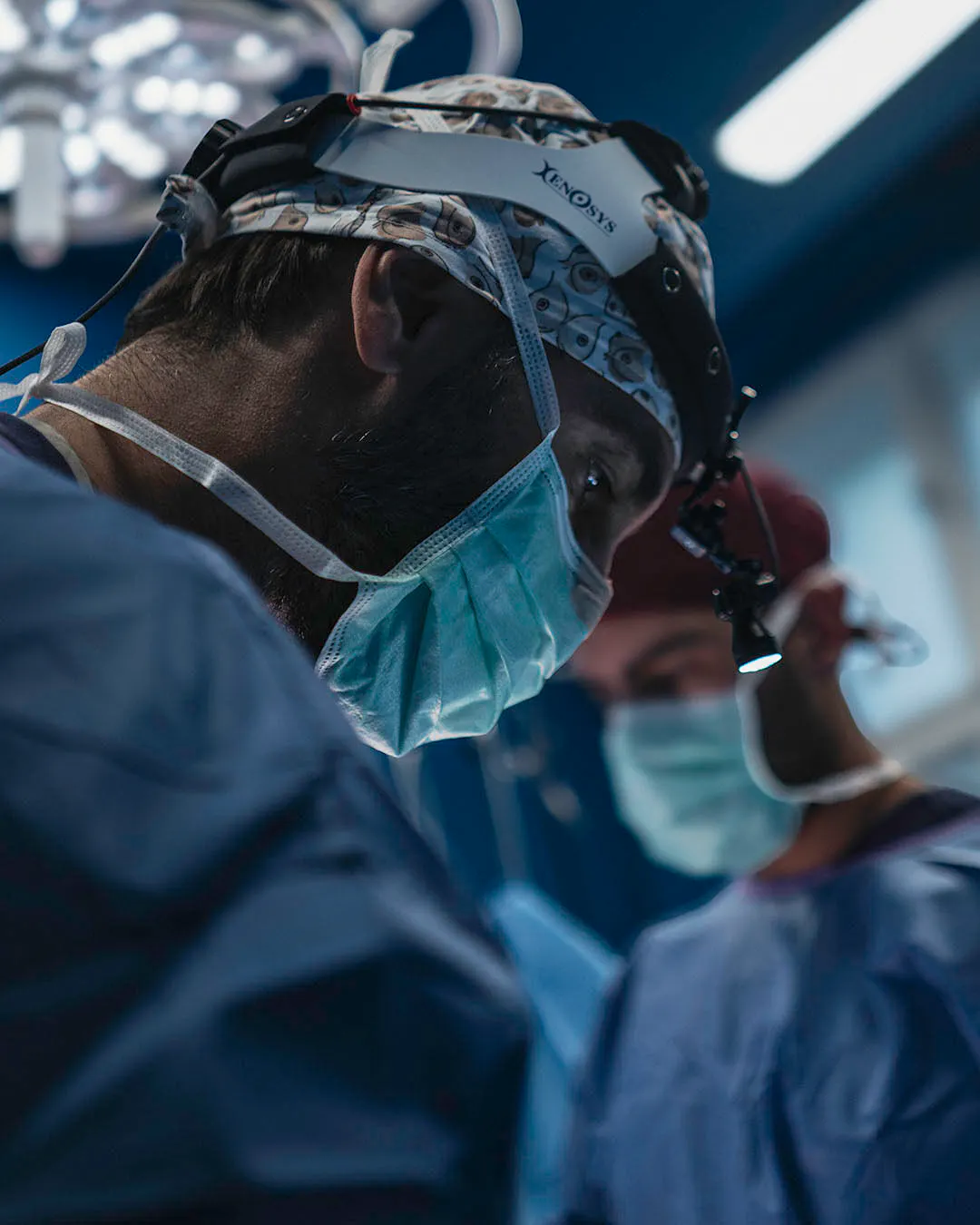
Do you have questions about the Deep Plane Facelift or want to know if a procedure is right for you? I would be happy to advise you personally at our practice clinic in Berlin.
You might also be interested in
Discover more treatments with us.