
EN

Lipedema
It was never just a matter of discipline.
What is lipedema?
Lipedema is a chronic fat distribution disorder that primarily affects women and is often associated with pain, tenderness, and a disproportionate increase in fat tissue in the legs and/or arms.
Many affected individuals report a feeling of tension, an increased tendency to bruise, and the experience that exercise, dietary changes, or weight loss can partially improve symptoms, but often do not sufficiently affect the affected body areas.
Lipedema is not a result of a lack of discipline and should not be equated with simple weight gain. Nevertheless, the condition is often recognized only after many years, leading numerous patients to endure a long journey of suffering before receiving the correct diagnosis.
Early diagnosis and a tailored treatment plan can help alleviate lipedema symptoms and sustainably improve quality of life. As a surgical treatment option, liposuction has established itself for lipedema – it aims to gently remove the affected fat tissue and reduce symptoms in the long term.
In a personal consultation, we analyze your individual situation, discuss possible treatment paths, and collaboratively develop a plan tailored to you – from lipedema diagnosis to aftercare.
Lipedema or overweight?

Many affected individuals hear for years that their symptoms are merely a result of being overweight or lack of exercise. However, lipedema can occur independently of body weight and is not equivalent to ordinary weight gain.
While excess body fat usually reduces evenly with weight loss, patients with lipedema often report that particularly the legs and/or arms remain disproportionately pronounced despite exercise, dietary changes, or significant weight reduction.
Typical signs of lipedema may include:
disproportionate fat increase in the legs and/or arms,
pain or tenderness of the tissue,
a feeling of tension and heaviness,
an increased tendency to bruise,
symptoms that worsen throughout the day,
the feeling of "losing weight everywhere – just not in the affected areas."
Not every disproportionate fat distribution is automatically lipedema. A careful examination and individual diagnostics are crucial to make the correct diagnosis and develop an appropriate treatment plan.
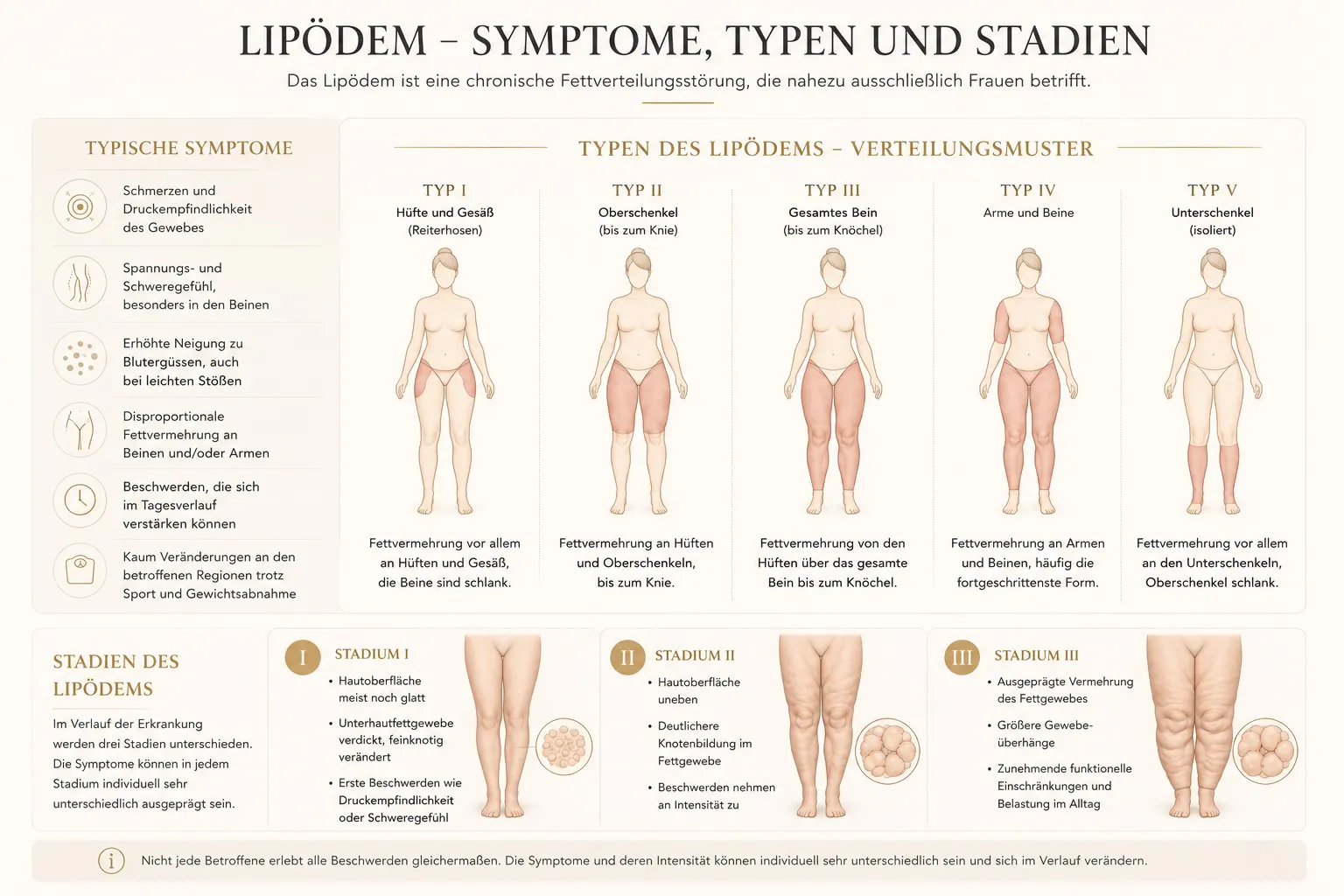
Symptoms of lipoedema
The symptoms of lipoedema can vary greatly and often develop gradually over many years. Many affected individuals report a feeling that "something is not right" long before a diagnosis is made. Typical symptoms

Pain and sensitivity of the tissue -
even light touches or slight pressure can be perceived as uncomfortable or painful.
Feeling of tension and heaviness, especially in the legs -
many patients describe a sensation that their legs become increasingly heavier throughout the day.
Increased tendency to bruising -
even minor bumps or touches can lead to visible bruises without any recollection of a corresponding trauma.
Disproportionate fat accumulation in the legs and/or arms -
the affected body areas often appear out of proportion to the rest of the body and respond significantly worse to weight changes.
The feeling of swollen, heavy, or tired limbs –
especially after prolonged standing or sitting, there can be a pronounced feeling of strain and fatigue.
Symptoms that can worsen throughout the day -
many affected individuals report an increase in symptoms with heat, physical exertion, or in the evening.
Little change in the affected areas despite exercise and weight loss -
while other body areas respond to dietary changes and exercise, the affected areas often remain largely unchanged.
Limitations in physical endurance and quality of life –
over time, everyday activities, sports, and overall well-being can be increasingly impaired.
Types and stages of lipoedema
Stages
- Stage I: The skin surface usually appears smooth. However, the subcutaneous fat tissue may already be thickened and show fine nodular changes. Initial symptoms such as sensitivity to pressure or a feeling of heaviness may occur.
- Stage II: The skin appears increasingly uneven, the nodular structure of the fat tissue becomes more pronounced, and symptoms often increase in intensity.
- Stage III: There is a pronounced increase in fat tissue with larger tissue overhangs and a growing limitation of mobility and quality of life.
Types (Distribution Patterns)
- Type I: Fat accumulation primarily on the hips and buttocks ("saddle bags")
- Type II: Fat accumulation on the hips and thighs down to the knees
- Type III: Fat accumulation of the entire legs down to the ankles
- Type IV: Additional involvement of the arms alongside the legs
- Type V: Primarily the lower legs are affected, while the thighs remain largely spared
Treatment Options for Lipedema
The treatment of lipedema is tailored to the individual symptom profile, the stage of the disease, and personal life circumstances. Not every patient requires the same therapy. The goal is to alleviate symptoms, improve quality of life, and maintain or restore physical resilience.


Surgical Treatment of Lipedema
Individual Concepts Instead of Standard Solutions
The surgical treatment of lipedema involves much more than just the removal of fat tissue. The goal is to reduce symptoms, improve mobility and quality of life, while carefully considering the individual anatomy of each patient.
Each patient comes with different prerequisites. The extent of symptoms, the affected body regions, skin quality, and personal expectations can vary significantly. For this reason, there is no standard solution – but rather individual treatment concepts that are specifically tailored to the respective starting situation.
At Stavrakis Aesthetics, years of experience in modern body contouring and liposuction are integrated into the treatment of selected lipedema patients. Precise and gentle liposuction techniques allow for a differentiated approach that is oriented to the individual needs and complaints of the patient.
In cases of reduced skin elasticity or an increased risk of excess skin, combining with BodyTite® may be beneficial. The radiofrequency-assisted tissue tightening supports natural skin contraction and can help further improve body contours.
Additionally, VASER®-assisted liposuction can be incorporated into the individual treatment plan. What matters is not just the technology itself, but its responsible and targeted application within a comprehensive concept tailored to the patient.
The focus is always on determining which treatment is appropriate for each patient – with the goal of sustainably alleviating symptoms, improving quality of life, and respecting natural body proportions.
Your Lipedema Journey at Stavrakis Aesthetics Berlin
Treatment Process

1. Personal consultation and medical history
The process begins with a detailed discussion about your symptoms, your medical history, and your personal goals. We will discuss which areas are affected, how long the symptoms have been present, and what conservative measures have already been taken.
2. Physical examination and assessment
The next step involves examining the affected areas. Typical signs of lipoedema, the distribution pattern, the current stage, and the quality of the skin will be assessed. The goal is to accurately capture the individual starting situation.
3. Individual treatment planning
Based on the examination, a personalized treatment plan will be developed. It will be determined which areas should be treated, whether multiple procedures are advisable, and which techniques—such as modern liposuction methods or complementary tissue-tightening measures—are appropriate for the individual case.
4. Preparation for the procedure
Before the surgery, all relevant organizational and medical aspects will be discussed. This includes the surgical planning, necessary pre-examinations, the selection of appropriate compression garments, as well as guidelines for behavior before the procedure and a realistic assessment of the healing process.
5. Surgical treatment
The surgical treatment is usually performed under general anesthesia. Depending on the severity of the lipoedema and the affected body regions, the therapy may be carried out in one or more sessions—either outpatient or inpatient, depending on the individual findings. The goal is the gentle removal of the diseased fat tissue while carefully considering the individual anatomy and symptoms.
6. Initial healing phase
In the first days and weeks after the surgery, swelling, bruising, and feelings of tension are normal and part of the natural healing process. Consistent wearing of the individually tailored compression garments is an essential part of the aftercare. Manual lymphatic drainage can be initiated early to reduce swelling and promote well-being. Light movement and adherence to individual recommendations further support recovery.
7. Follow-up appointments and long-term care
Regular follow-up appointments allow for the assessment of the healing process and the adjustment of further measures. Depending on the initial situation, additional treatment may be advisable. The goal is a sustainable improvement in symptoms, mobility, and quality of life.
Why choose Stavrakis Aesthetics for your lipedema treatment?
The surgical treatment of lipedema requires not only technical skill but also a deep understanding of anatomy, function, and individual complaints. The decision for or against surgery—and the choice of the appropriate technique—should always be based on a careful analysis of the starting situation.
At Stavrakis Aesthetics, the extensive experience of our chief physician in plastic, aesthetic, and reconstructive surgery, as well as his comprehensive expertise in modern liposuction, is incorporated into every individual treatment plan. Treating patients with lipedema often requires more than standardized liposuction: skin quality, soft tissue conditions, functional complaints, and long-term body contour must all be considered.
Through experience with modern liposuction techniques—including VASER®-assisted liposuction (ultrasound-assisted), radiofrequency-assisted procedures like BodyTite®, and classic tumescent techniques—the surgical strategy can be individually tailored to the specific situation. What matters is not just the technology itself, but its targeted and responsible application.
From the initial consultation through the surgical treatment to structured aftercare, we personally accompany our patients—with the goal of alleviating complaints, improving quality of life, and simultaneously respecting natural body proportions.
Calculated according to the German Medical Fee Schedule (GOÄ) and your individual treatment plan.
Costs & Financing of Your Lipedema Treatment
At a glance

Individual Cost Planning
Based on the German Medical Fee Schedule (GOÄ) and your personalized treatment plan.

From €5,000 per Procedure*
Depending on the treatment area and surgical extent.

Financing
Flexible payment plans available.

Cost Transparency
No hidden additional costs.

VASER® & BodyTite Technology
Advanced technologies for selective fat removal and skin tightening.

Individual Treatment Concept
Outpatient or inpatient treatment depending on the extent of surgery.

24/7 Postoperative Emergency Care
Available around the clock whenever you need us.
Do You Have Questions About Lipedema Surgery?
Every case of lipedema is unique. We are happy to assess your individual situation, answer your questions, and explain your treatment options. Contact us via WhatsApp or schedule a personal consultation with Themistoklis Stavrakis, M.D.
What Is Included in the Treatment Fee?
More Than Just Surgery
At SA Aesthetics, your lipedema treatment includes far more than the surgical procedure itself. From your comprehensive consultation and individualized surgical planning to structured postoperative care, we guide you through every step with a personalized treatment concept. Our goal is maximum safety, meticulous surgical planning, and long-lasting results.
✔ Surgery performed by Themistoklis Stavrakis, M.D., Board-Certified Plastic & Aesthetic Surgeon with many years of international experience in lipedema surgery.
✔ Personal consultation and individualized surgical planning.
✔ Lipedema surgery using VASER® and BodyTite technology, where indicated.
✔ Individualized outpatient or inpatient treatment depending on the extent of surgery.
✔ 24/7 postoperative emergency support.
✔ Transparent treatment and cost plan.
Individual Costs of Your Lipedema Surgery
Transparent Costs – Tailored to Your Treatment
The cost of lipedema surgery depends on the stage of the disease, the number of treatment areas, and the overall surgical complexity. As treatment often requires multiple procedures, every operation is individually planned according to your anatomy, symptoms, and treatment goals.
The total cost also reflects the use of advanced technologies such as VASER® and BodyTite®, the duration of surgery, and the extent of treatment. These modern technologies enable selective fat removal while preserving surrounding tissues and, where appropriate, provide additional skin tightening.
Following your personal consultation, you will receive a transparent and individualized treatment and cost plan. All medical services are itemized according to the German Medical Fee Schedule (GOÄ). With prices starting from €5,000 per procedure*, we provide an initial cost estimate before your consultation.
*The final price per procedure depends on the stage of lipedema, the treatment area(s), and the overall surgical complexity.
Frequently asked questions about lipoedema - liposuction
Exercise and a balanced diet can improve overall well-being and help stabilize body weight. However, the diseased fat tissue of lipoedema is generally not eliminated by these means.
This depends on the affected body regions, the extent of the condition, and individual symptoms. While a single surgery may be sufficient in some cases, multiple procedures may be advisable for more pronounced findings to achieve a safe and optimal result.
Whether multiple areas can be treated in one session depends on the individual findings, the planned treatment scope, and the medical prerequisites. This will be discussed during the personal consultation.
Yes. Wearing the individually tailored compression garments is an essential part of aftercare and supports the healing process. The duration depends on the extent of the procedure and the individual starting situation.
Yes. Manual lymphatic drainage is an essential part of our post-treatment concept following lipedema liposuction. It supports the healing process, can help reduce swelling, and improve well-being during the recovery phase.
We recommend starting lymphatic drainage early after the procedure and will tailor the frequency and duration to the extent of treatment and the healing process. In combination with compression therapy and regular follow-ups, it forms an important component of postoperative care.
The fat cells removed during liposuction do not regenerate. However, since lipedema is a chronic condition, changes can occur over the long term. Therefore, maintaining a healthy lifestyle and regular follow-ups remain important.
This depends on the individual starting situation. In cases of pronounced findings, advanced stages, or significantly reduced skin elasticity, additional tightening may be sensible or necessary. In selected patients, the combination of liposuction with tissue-tightening procedures like BodyTite® can help support natural skin contraction and reduce the risk of remaining skin excess. However, in more pronounced cases, additional tightening surgeries—such as in the thigh area—may be required to sustainably improve both functional complaints and body contour. What measures are appropriate depends on skin quality, the extent of tissue changes, and personal treatment goals, and will be determined together during the consultation.
Surgical treatment may be appropriate when complaints persist despite conservative measures and quality of life is increasingly impaired. The right timing is individual and should be decided based on the complaints, the course of the disease, and personal life situation.
The conditions for cost coverage by health insurance depend on the applicable legal regulations and the individual insurance relationship. Patients with statutory health insurance should inquire early with their health insurance provider about the current requirements. Since Stavrakis Aesthetics operates as a self-pay and private practice, treatment for patients with statutory insurance is generally on a self-pay basis. Direct billing with statutory health insurance is therefore not possible. For privately insured patients, reimbursement of treatment costs may be possible depending on the individual insurance contract. We are happy to assist you with the necessary documents and advise you in a personal conversation about your individual options.
Looking for individual consultation?
Would you like to know if lipedema liposuction is an option for you or wish for an individual assessment of your situation? In a personal consultation, we will answer your questions, discuss possible treatment options, and develop a treatment plan tailored to your needs.
You might also be interested in.
Discover more treatments.